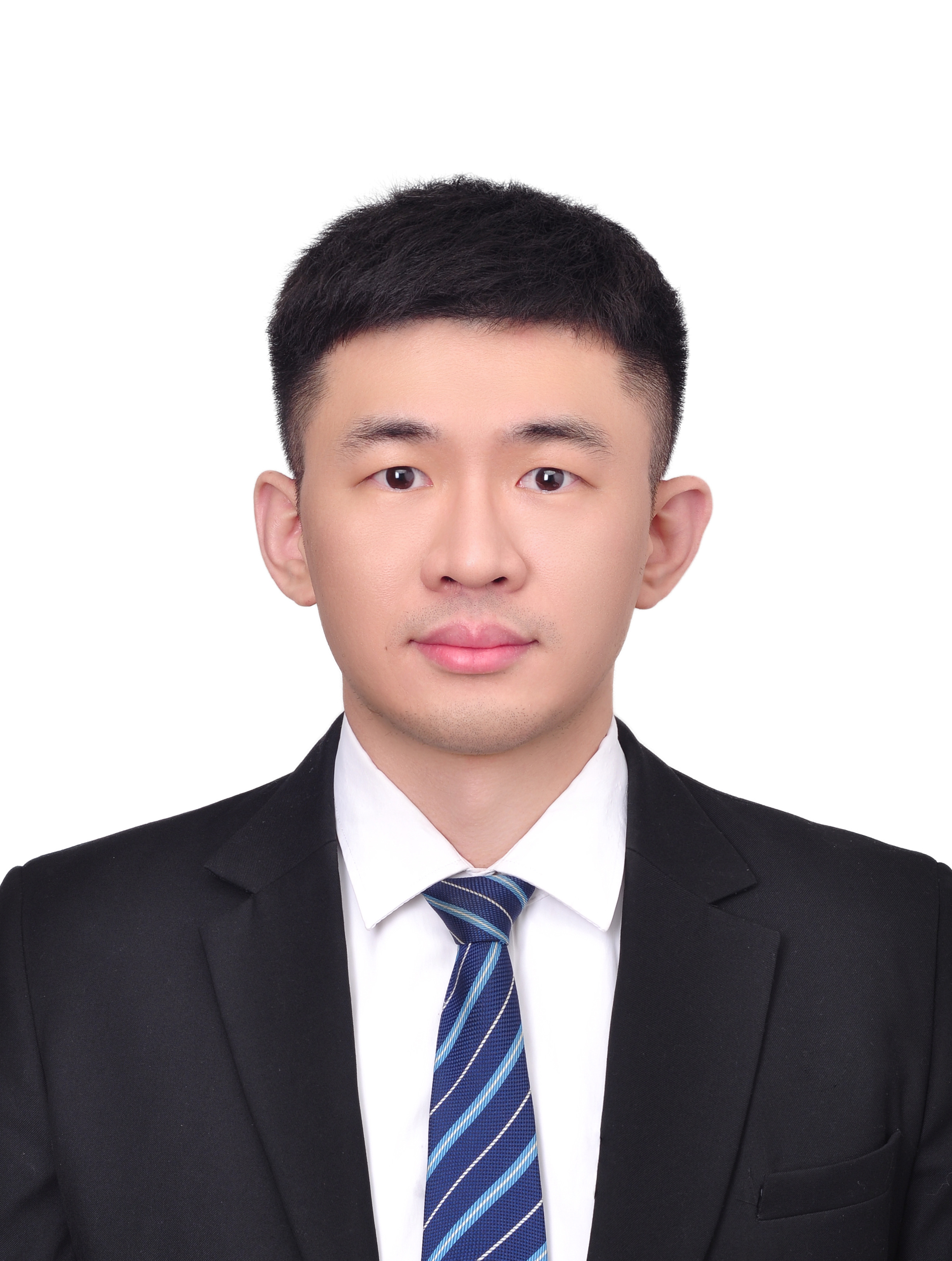
Research Interest and Biography
Our group advances trustworthy, physics-grounded, and efficient machine learning for complex dynamical systems and AI for Science. Our work spans robust perception and control (adversarial defense, out-of-distribution generalization, interpretable decisions, learnable safety barriers), continuous-time modeling (ODE/FDE/SDE, PINNs, graph dynamics) for accurate long-horizon prediction, and scalable foundation models via quantization and ultra-efficient spiking/binary networks for edge deployment.
I am currently a Professor (Special Appointment) at the University of Science and Technology of China (USTC). Before that, I was a research fellow at Nanyang Technological Universty (NTU). I received the B.S. degree in Electronic Information Science and Technology from USTC in 2015, and the Ph.D. degree from NTU in 2020, supervised by Prof. Tay Wee Peng.
Academic services: ELSEVIER Signal Processing, NeurIPS, ICRL, ICML, IEEE TSP, AAAI, CVPR, IEEE TITS, TNNLS, IEEE L-CSS, IJCAI, PR, and others.
Advertisements
Multiple opening Ph.D. and M.Sc. positions are available.
News
One paper is accepted to NeurIPS 2025.
This paper proposes a generalized fractional differential equation (FDE) framework that replaces fixed fractional kernels with learnable attention kernels, enabling input-adaptive memory weighting for systems with long-range dependencies.
One paper is accepted to CVPR 2025.
This paper advances UAV place recognition by fusing ground cameras and LiDAR with aerial imagery via a manifold-based neural ODE and multi-domain alignment, achieving state-of-the-art cross-view retrieval on large-scale benchmarks.
Two paper are accepted to AAAI 2025.
These two papers examine the use of fractional differential equations (FDE) in driving machine learning with the aim to improve the training efficiency and model effectiveness.
One paper is accepted to NeurIPS 2024 as Spotlight.
Our paper introduces a highly general continuous GNN framework inspired by differential equations. This framework features a learnable probability distribution over a range of real numbers for the derivative orders.
One paper is accepted to TITS.
Our paper proposes multi-modal place recognition models that utilize global fusion with manifold metric attention, achieving state-of-the-art performance on three large-scale benchmarks.
One paper is accepted to ICLR 2024 as Spotlight.
Our paper introduces a novel continuous GNN framework that incorporates fractional differential equations.
Three papers are accepted to AAAI 2024.
- Coupling Graph Neural Networks with Fractional Order Continuous Dynamics: A Robustness Study
- DistilVPR: Cross-Modal Knowledge Distillation for Visual Place Recognition
- PosDiffNet: Positional Neural Diffusion for Point Cloud Registration in a Large Field of View with Perturbations
One paper is accepted to NeurIPS 2023 as Spotlight.
Our paper introduces a novel physics-driven GNN that leverages conservative Hamiltonian flows and Lyapunov stability to significantly enhance robustness against adversarial perturbations.
One paper is accepted to ICML 2023.
Our paper presents a novel approach for graph node embedding that addresses the challenge of varying embedding spaces for different data types.
One paper is accepted to IJCAI 2023.
Our paper introduces a novel GNN approach to address the challenge of heterophilic graphs by incorporating the convection-diffusion equation.
One paper is accepted to CVPR 2023.
Our paper introduces a new model for LiDAR pose regression.
One paper is accepted to AAAI 2023.
In this paper, to deal with challenging driving environments, we propose RobustLoc, which derives its robustness against perturbations from neural differential equations.